Tax issues, CCAO member races on the ballot tomorrow
Tomorrow is the 2026 General Election. Ohioans across the state will head to their polling places to cast votes on a wide variety of elected positions and local ballot issues.
There will be just shy of 90 county property tax levies on the ballot. The majority (57 levies) are for human services functions such as mental health and recovery boards, senior services, and boards of developmental disabilities.
Twenty-nine of the levies seek new money (either a renewal with an increase or an entirely new levy).
More information on property tax levies on the ballot is available in the October 23 issue of Statehouse Report.
There are three county sales tax issues on the ballot, all of which are renewals. More information about these is available in the October 30 issue of Statehouse Report.
There are 105 CCAO member seats on ballot tomorrow. This includes one seat in the 86 statutory counties, six Cuyahoga County Council seats, the Cuyahoga County Executive seat, three Summit County Council seats, and nine unexpired seats.
There are 71 incumbents seeking reelection; of these, 29 are running unopposed. There are an additional 11 uncontested races that do not feature incumbents.
When considering these races, along with contested races that do not feature an incumbent, CCAO is guaranteed at least 34 new members. Of these guaranteed new members, one will be a returning CCAO member and two others may be.
Ken Stiverson is unopposed in the Marion County Commissioner race. He previously served as a Marion County Commissioner from 2011 to 2022.
Terry Boose is one of the two candidates for the expired Huron County Commissioner seat. He previously served as a Huron County Commissioner from 1997 to 2004 and again from 2017 to 2024.
Mark Van Buren is one of the two candidates for the Licking County Commissioner seat. He previously served as a Licking County Commissioner in 2008.
Twelve Association board members are up for reelection tomorrow.
CCAO Board of Directors
- Opposed
- Casey Kozlowski, CCAO 1st Vice President and Ashtabula County Commissioner
- Chris Ronayne, Cuyahoga County Executive
- Carolyn Rice, Montgomery County Commissioner
- Alan Harold, Stark County Commissioner
- Unopposed
- Mike Halleck, Columbiana County Commissioner
- Jeff Fix, Fairfield County Commissioner
- Dick Gould, Greene County Commissioner
- Melissa Bell, Muskingum County Commissioner
- Scott Owen, Perry County Commissioner
- Jon Hofstetter, Wayne County Commissioner
CEBCO Board of Directors
- Unopposed
- Bartley Westfall, Williams County Commissioner
CORSA Board of Directors
- Opposed
- Dave Wilson, Guernsey County Commissioner
- Unopposed
- Melissa Bell, Muskingum County Commissioner
CCAO has produced lists of county ballot issues and CCAO member races.
The results of the county ballot issue votes and CCAO member elections will be shared in the November 6 issue of Statehouse Report and the November 9 issue of Counties Current.
The November 6 issue of Statehouse Report will also include results of General Assembly and statewide officeholder races.
Last week for Winter Conference early bird prices
CCAO and CEAO are hosting our annual Winter Conference from December 9-11 at the Hilton Downtown Columbus. Registration is open, but early bird registration prices end on November 9 (NEXT MONDAY), so register today!
Register Here
| Registration Type |
Early Bird Price
(Through November 9)
|
Regular Price
(After November 9) |
| Full Conference |
$525 |
$625 |
| Single Day |
$380 |
$480 |
| Spouse/Guest Flat Fee |
$200 |
$300 |
| Affiliate Group, Meetings Only |
$125 |
$175 |
The event will feature sessions on data centers, the state's economic outlook, how to ensure the community understands where tax revenue goes, and more.
View the Tentative Agenda
Association publishes the Fall 2026 edition of County Leader
Read the Issue Here
Inside, you'll explore a range of stories packed with timely and valuable information for counties, including:
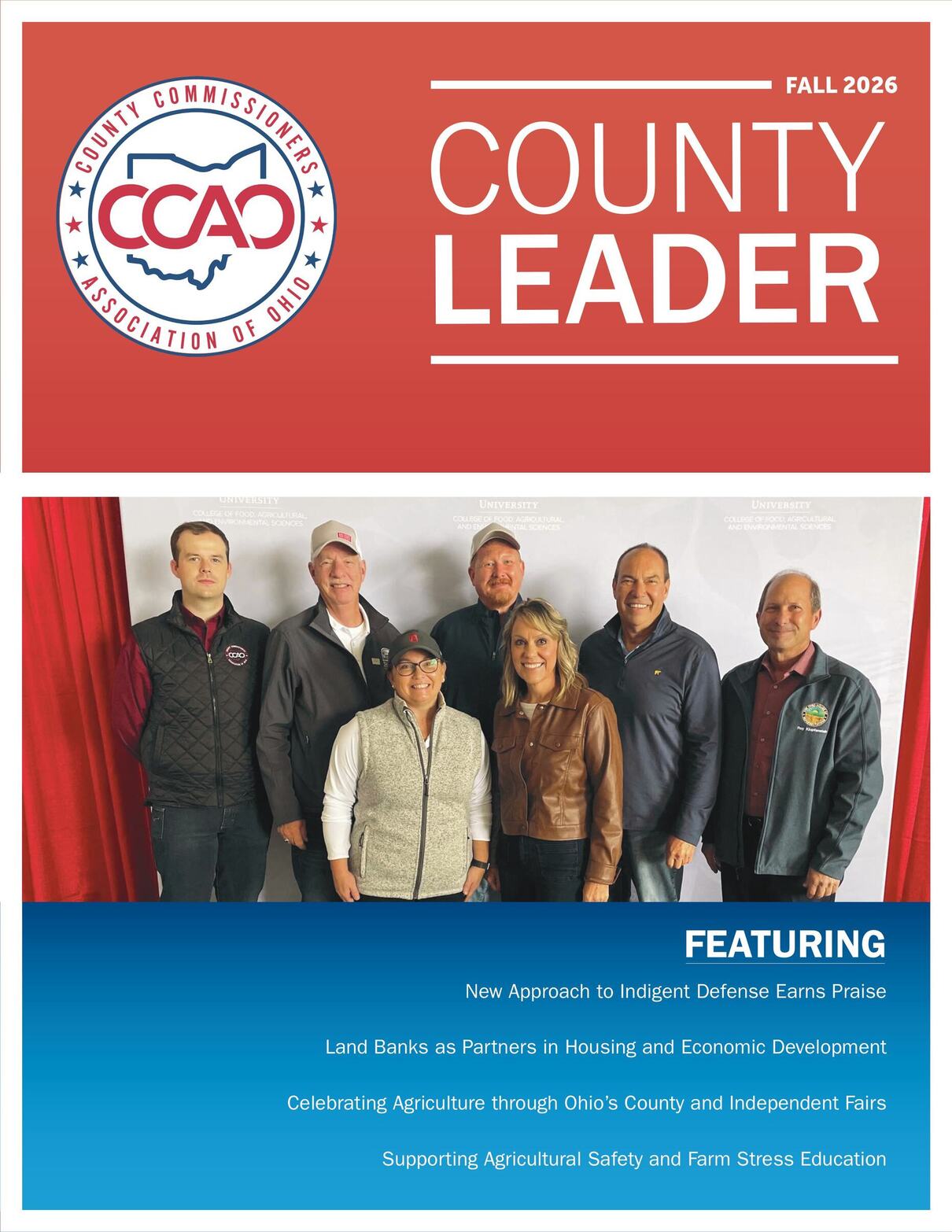 |
Praise for the Regional Hub Model of Indigent Defense
The Role of Land Banks in Housing and Economic Development
How County and Independent Fairs Celebrate Ohio Agriculture
Also:
- Policy Update: Gas Tax Holiday and Transportation Funding
- How OSU Extension Supports Agriculture Safety and Farm Stress Education
- Profile of County Next Generation 9-1-1: Clark County
- Voice of County Leader: CCAO 1st Vice President and Ashtabula County Commissioner Casey Kozlowski
- Messages from 2026 CCAO President Denise Driehaus and CCAO Executive Director Cheryl Subler
|
- CORSA News
- CEBCO News
- CCAO Service Corp News
- CCAO R&E News
- OCERP News
Please reach out to us at comms@ccao.org with feedback and future story ideas! Top Top Auditor of State releases Medicaid Performance Audit
Earlier this month, the Auditor of State (AOS) released the performance audit of the Ohio Department of Medicaid’s (ODM) Next Generation initiative. House Bill 96, the most recent state operating budget, mandated the audit of ODM’s strategic planning and performance evaluation, county oversight, contract management, and provider claim processing. In Ohio, the county JFS agencies administer Medicaid eligibility while the state supervises and sets policies.
The report issues nine recommendations and one issue for further study across three categories: Strategic Planning and Management; County Oversight; and Stakeholder Engagement.
Through the audit process, the auditors interviewed 20 county JFS agencies representing 22 counties. Detailed summaries of the county oversight recommendations are below.
Recommendation 5: Improve Collaboration with the Ohio Department of Job and Family Services (ODJFS) and the Department of Children and Youth (DCY) to Align Eligibility Determination Rules, Policies, and Processes Where Possible
Almost all the counties interviewed identified the lack of communication and misalignment between ODM, ODJFS, and DCY as an issue that impacts their operations and has become more prominent over time.
Specific issues identified included:
- Lack of alignment of rules, policies, and processes between programs;
- Inability to use the same documentation or systems for information verification between programs;
- Competing priorities and a lack of understanding of other program responsibilities;
- State agencies not answering questions about other programs;
- Lack of alignment of renewal timelines between programs and inability to shift timelines to align; and
- Impact of program changes on other programs and quantity of changes across programs.
The audit states that aligning policies, procedures and training across the three supervising agencies would improve the efficiency and effectiveness of application processing and eligibility determination and reduce duplication.
Recommendation 6: Work with ODJFS and CDJFS Agencies to Identify Issues with Ohio Benefits and Develop Solutions
A common theme among all counties interviewed was challenges with the Ohio Benefits system – the technology system used by county JFS agencies to process applications and determine eligibility across public assistance programs. The issues reported are summarized in the chart below.
| Commonly Identified CDJFS Issues with Ohio Benefits |
| General Functionality |
- Inconsistent functioning
- System updates
- Conflicts between programs
- Opportunity for error
- Lack of information about errors
|
| Determination Accuracy |
- Quantity and frequency of overrides and workarounds required for the system to function correctly
- Online ticket portal submission
|
| Alerts |
- Quantity of alerts that caseworkers must process
- Must sort through many alerts to find those that are relevant to eligibility
|
| Automation |
- Passive renewal issues
- Bots not functioning correctly or creating more work for caseworkers
|
| Self-Service Portal |
- Not user-friendly
- Difficult to navigate
- Applications come in incomplete or multiple times
- New indications
|
| Source: Medicaid Performance Audit, CDJFS Feedback |
The audit stresses the impact of these challenges on timely and accurate eligibility determinations and renewals, and the importance of ODM consulting county JFS agencies when considering changes to Ohio Benefits. The audit recommends ODM work with ODJFS and county JFS agencies to identify and develop solutions to:
- Improve the functionality and accuracy of Ohio Benefits;
- Reduce the number of overrides and workarounds required;
- Reduce the quantity of alerts;
- Improve automation; and
- Make the Ohio Benefits Self-Service Portal more user friendly.
Recommendation 7: Enhance Data Collection to Identify Issues Impacting Application Processing Timeliness
The audit finds that Ohio has historically fallen below the national average for Medicaid application processing timeliness, while also concluding that ODM does not use county-level data to identify the root cause of delays in application processing.
The audit also speaks to county JFS agency workforce and funding concerns, citing difficulty recruiting and retaining workers leading to high caseloads which affect timeliness. The funding analysis reads, in part:
Over the past 12 years, Ohio’s standard state funding allocated to CDJFS agencies for Medicaid appropriations has only increased 1.9 percent. In the last few years, ODM has provided additional funding to encourage improvements in application processing timeliness, referred to as incentive funding. When this incentive funding is included, state Medicaid funding for CDJFS agencies has increased by 15.0 percent. However, counties indicated that they are not able to rely on this funding, as it depends on their quarterly performance, and therefore cannot use it to hire additional staff members or increase wages. In comparison, Ohio’s state appropriations for Medicaid administration at the state level have increased by 35.3 percent.
While state funding for CDJFS agencies has remained stagnant over time, county caseloads have increased. From CY 2017 to 2025, the number of Medicaid applications received increased by approximately 20.8 percent. In addition to this, the CDJFS agencies we interviewed noted that policies, processes, and systems have become more complicated over time while expenses have risen. This has resulted in what the majority of counties described as unmanageable caseloads. (page 108-109)
Auditors recommend using county-level data to develop process improvements and solutions in conjunction with county JFS agencies to ensure that solutions are “appropriate and feasible.”
Recommendation 8: Expand, Standardize, and Communicate Quality Control Efforts to Improve the Accuracy of Eligibility Determinations
The audit discusses the limitations of ODM’s existing quality control reviews, finding they are insufficient to evaluate and improve county eligibility operations. Auditors also discuss the lack of communication with county JFS agencies regarding the quality control reviews that are performed.
While ODM complies with current federal standards, auditors recommend the department use quality control processes for performance management, which would require expanding and standardizing the process year over year. The recommendation also emphasizes communication with county JFS agencies about the results of the quality reviews as critical for improving performance.
Issue for Further Study: The Passive Ex Parte Renewal Process
The audit also raises concerns about ex parte Medicaid renewals, the Ohio Benefits system processes the renewal automatically using electronic data sources. Counties report that some individuals may remain enrolled despite no longer meeting eligibility requirements. Auditors identified this as an issue requiring further study, recognizing that a passive renewal process can also reduce county workloads and prevent unnecessary coverage losses.
The other recommendations issued in the audit are:
- Recommendation 1: Align Strategic Plans and Program Evaluation Efforts with Operational Strategies to Improve Agency Outcomes
- Recommendation 2: Enhance Transparency of Caseload and Financial Forecasting Materials
- Recommendation 3: Improve Contract Management Practices
- Recommendation 4: Collect and Utilize More Detailed Claim Payment Timeliness Metrics to Improve Transparency and Performance Management
- Recommendation 9: Develop and Utilize a Stakeholder Engagement Plan
The full performance audit can be found here. Members with questions about the audit should contact Rachel Reedy at rreedy@ccao.org. Top State funding opportunities
The table below contains current state grant or loan programs. A more comprehensive list can be found on the Ohio Grants Partnership webpage.
Grant Program
|
Brief Summary
|
Eligibility Criteria
|
Amount Available
|
Application Due Date
|
| Violent Crime Reduction Grant |
To assist local communities in reducing and preventing violent crime using proven or promising crime reduction strategies. |
Law enforcement agencies
|
Unspecified
No local match required
|
November 16, 2026 |
| .gov Domain Migration Grant |
To help local governments transition their websites to the more secure ".gov" domain. |
Local governments, with priority for those serving less than 40,000 residents
|
Maximum award: $9,500
20% local match required
|
November 20, 2026 |
|
Domestic Violence Awareness Month Grants
(must take brief preapplication survey)
|
To assist in the response to domestic violence incidences and to assess the likelihood of future incidences. |
Law enforcement agencies
|
Unspecified
|
November 30, 2026 |
| Water Cybersecurity Grant |
To enhance the cybersecurity protections for water and wastewater systems. |
Local governments, with priority for those serving less than 40,000 residents
|
Unspecified
40% local match required
|
December 4, 2026 |
| Lake Erie Community Grant |
To help create healthy, thriving communities by providing resources and support to address local environmental challenges within the Lake Erie Basin. |
Local governments and non-profits within the Lake Erie Basin (page 45 & 46)
|
Maximum award: $350,000
|
December 16, 2026 |
| H2Ohio Conservation Ditch Grant Program |
To provide reimbursement for the construction of two-stage and self-forming conservation ditches. |
Soil and water conservation districts and county engineers |
Unspecified
Reimbursement model
|
June 1, 2027
(Rolling until) |
Federal funding opportunities
The table below contains a sampling of current federal grant or loan programs. A full list can be found on Grants.gov.
Grant Program
|
Brief Summary
|
Eligibility Criteria
|
Amount Available
|
Application Due Date
|
| Family Treatment Court Program (New Courts) |
To support the implementation of family treatment courts. |
General availability to entities without a family treatment court. |
Maximum award: $850,000
Local match of at least 25%.
|
November 16, 2026 |
| Family Treatment Court Program (Existing Courts) |
To support the expansion of family treatment courts. |
General availability to entities with a preexisting family treatment court. |
Maximum award: $750,000
Local match of at least 25%.
|
November 16, 2026 |
| Opioid Affected Youth Initiative |
To reduce violent crime and overdose deaths through prevention, intervention, and treatment strategies. |
General availability |
$8.9 million available
No match required
|
November 16, 2026 |
| Expanding Youth Access to Community-Based Treatment |
To support the development and expansion of community-based treatment programs serving youth. |
General availability |
$4.0 million available
No match required
|
November 16, 2026 |
| Strategies to Support Children Exposed to Violence |
To improve communities' ability to help children exposed to violence in their homes, schools, and communities. |
General availability |
$7.3 million available
No match required
|
November 16, 2026 |
| Juvenile Justice System Enhancements |
To improve the cost-effectiveness of the juvenile justice system by implementing targeted solutions to high-cost crime drivers. |
General availability |
$4.0 million available
No match required
|
November 16, 2026 |
| Mentoring for Youth Impacted by Opioids and Substance Use |
To support high-quality mentoring services for youth currently using or dependent on substances, as well as youth with close family members using or dependent on substances. |
General availability |
$16.5 million available
No match required
|
November 16, 2026 |
| Strengthening Operations to Reduce Crime and Recidivism |
To support projects that address one or more urgent local justice system challenges. |
General availability |
$12.7 million available
No match required
|
November 20, 2026 |
| Title X Family Planning Services Grants |
To promote the general family planning programs and goals under Title X of the Public Health Service Act. |
General availability |
Maximum award: $22 million
Local match of between 1% and 10%
|
January 9, 2027 |
Top Each week Counties Current highlights the happenings in our counties in the words of their local media.
One story from each of the CCAO's five districts is highlighted, and on occasion other stories may be highlighted as well.
A paid subscription may be required to view the full article in some cases.
Northwest District
Seneca County approves soil testing at WIN Waste amid concerns over state oversight
WTOL, October 29, 2026
Seneca County health officials have approved independent soil testing at the WIN Waste landfill near Fostoria, saying Ohio EPA declined to require laboratory analysis to determine whether contaminants remain in an area being excavated for the landfill’s expansion.
The Seneca County General Health District announced the board of health’s decision Thursday, Oct. 29. The district says testing is needed to assess whether chemicals remain in the soil before the excavated area is covered with structural backfill.
The announcement does not include test results establishing whether those contaminants are currently present.
“This is a question about whether residual benzene, cyanide, and heavy metals are being permanently sealed beneath structural backfill,” Health Commissioner Julie Richards said in the release. “Right now, the EPA is relying solely on a visual inspection of the excavation bottom, and that's just not an adequate testing method to ensure our residents are safe.”
WTOL 11 has reached out to both WIN Waste and the Ohio EPA for further comment on the situation and will update this article once responses are received.
The testing will focus on an area where waste is being excavated and relocated as part of the expansion project at the landfill, formerly known as Sunny Farms.
According to the health district, more than 41 of an anticipated 162 test pits, each five feet deep, have been dug to visually inspect for remaining waste. The district says Ohio EPA has not required chemical laboratory analysis of the soil.
Northeast District
Lorain County commissioners exploring audit of court, hint at countywide audit
Morning Journal, October 30, 2026
Lorain County commissioners are inquiring with the state auditor about conducting a performance audit of the county’s Domestic Relations Court, as litigation remains pending over the judges’ budget.
At a recent commissioners’ meeting, Commissioner David J. Moore asked Interim County Administrator Karen Perkins to contact Ohio Auditor Keith Faber’s office in regard to beginning an audit.
“I’ll be happy to make that call,” said Perkins.
“It’s really to help them, in my opinion,” said Commissioner Marty Gallagher, pointing out that in the private business sector, banks regularly review their clients’ portfolios.
“This is very similar in my eyes,” Gallagher said.
Their decision follows on the heels of agreeing an audit must be conducted at the county auditor’s office due to financial obligations that have not been met.
“This board is in the middle of litigation with domestic relations (court) and that’s because we cut a nonmandated service that they were providing,” Moore said.
The domestic relations judges filed a complaint in court after they learned of the decrease in their budget late last year.
Meanwhile, the domestic relations judges have gone over budget this year, Moore also said.
“This board has been committed to not micromanaging departments or trying to micromanage other electeds, which we don’t have the authority to do anyways,” said Commissioner Jeff Riddell.
“Rather than file a complaint and treating this as an adversarial relationship, the performance audit is so we can understand what we don’t understand,” Riddell also said.
The performance audit reviews staffing and organizational structure, in addition to many other aspects of the department, and compares those statistics with other counties of similar size and best practices.
Central District
Rising felony caseload prompts 16-percent budget increase request from Richland County prosecutor
Richland Source, October 27, 2026
The Richland County Prosecutor’s Office received about 5 percent of the county’s $49.6 million general fund budget in 2026.
At about $2.5 million, it’s the second largest general fund office expense behind the sheriff’s office allocation of $20.9 million, which is around 42 percent of the overall pie.
But a request to add two additional assistant prosecutors and a new software service had 100 percent of the county commissioners’ attention during a nearly hour-long budget meeting on Tuesday.
Prosecutor Jodie Schumacher presented a $2.99 million funding request for 2027, drawing pushback from Commissioner Tony Vero over a lack of advance documentation and proposed spending increases.
The proposal would be a16.5-percent increase over what commissioners appropriated for the prosecutor’s office when they allocated $2.57 million.
A sizeable portion of the increase, around $199,000, would be approximately $164,000 for the two new assistant prosecutors, as well as pay increases for current staff.
Schumacher, joined by First Assistant Prosecutor Bryan Dove, centered their request on two major additions: adding two assistant prosecuting attorneys to handle felony caseloads and acquiring the Axon Justice digital evidence management software, estimated at $54,000 for 2027.
“(Axon Justice) is a digital evidence retention system, but it’s not just a retention system. It allows prosecutors to review cases’ digital evidence efficiently. It allows us to prep for trials more efficiently … synthesizing large-volume documents, such as downloads of phones, computers, etc., into the most relevant of items,” the prosecutor said.
The presentation met immediate resistance from Vero, who criticized Schumacher for failing to provide her slide deck and comparative spreadsheets from other counties prior to the meeting.
Southwest District
Clark County approves emergency funds to fix cracked jail column
Springfield News Sun, October 29, 2026
After some Clark County Jail inmates were moved to another facility because of structural damage, commissioners approved spending over $14,000 to temporarily fix the issues.
During a recent structural damage inspection of the jail, it was found that an exterior support column was significantly cracked and in need of immediate repair, according to Clark County Sheriff Chris Clark. After further inspection by a structural engineer, it was determined the support column needs to be braced and supported until repairs can be made.
Clark County commissioners approved an emergency contract at their Wednesday, Oct. 28 meeting with Bruns Construction for $14,535 from the permanent improvement fund for temporary shoring to repair the deteriorated columns.
“We are working on getting temporary shoring in place, which should take about a week. As far as I know, there are engineers working on the long-term fix and I do not have an update on what that looks like or how long that may take,” he said.
“Out of an abundance of caution,” inmates in the housing areas directly affected by that support column were removed and temporarily transferred to the Logan County Jail, a move Clark said is expected to be short term and temporary.
Clark said 45 inmates were taken to the Logan County Jail at a cost of $65 per inmate, per day, not including medical expenses, which is $2,925 total per day. However, he said the number of inmates could fluctuate up or down while things are being fixed because of releases, intake, etc.
Once the shoring is complete, Clark said they’ll work with engineers and the Ohio Department of Rehabilitation and Corrections to make sure they are “100% safe” to move inmates back into the affected area.
“The remaining areas of the jail remain unaffected and are still up and operating. The remaining support columns were all inspected and, outside of some superficial repairs, were deemed structurally sound,” he said, explaining all other areas remain safe for inmate housing.
The current, almost-50-year-old facility, housed in the public safety building downtown with the police division and sheriff’s office, requires more than $2 million in repairs and improvements, including a new roof, jail locks, HVAC equipment, boilers and chillers.
Southeast District
New planning effort seeks to guide Tuscarawas growth
Lexington Herald Leader, October 30, 2026
Tuscarawas County has launched a comprehensive land-use planning effort aimed at guiding future growth, development and preservation throughout the county.
The initiative reached its first major milestone with the inaugural Public Steering Committee meeting on Oct. 15, according to a community announcement. The planning process is partially funded through a grant from the Ohio Department of Agriculture awarded to the Tuscarawas County Planning Commission.
Representatives from townships and municipalities joined stakeholders from agriculture, economic development, transportation, utilities, health and housing during the first steering committee session. County officials said the process is intended to create a long-term framework for balancing development needs with preservation goals across the region.
"Preserving our county's rural character while planning for responsible growth requires a shared vision," Tuscarawas County Commissioner Kristin Zemis said. "This initiative gives our townships, municipalities, and community members a direct seat at the table to shape the local landscape for generations to come."
County officials said public involvement will play a central role in development of the plan. In addition to ongoing Steering Committee meetings, the county plans to hold public events, workshops and other opportunities for residents to provide feedback and share their priorities for the future of the community. Top NOVEMBER 3
General Election
NOVEMBER 6
CORSA Board of Directors Meeting
NOVEMBER 10
OCCO Legislative Reception
NOVEMBER 11
Veterans Day - Holiday
NOVEMBER 13
CEBCO Board of Directors Meeting
NOVEMBER 20
CCAO Board of Directors Meeting
NOVEMBER 26
Thanksgiving - Holiday
DECEMBER 9-11
CCAO/CEAO Annual Winter Conference Top
|