|
|
September 28, 2026
County commissioners, legislators, and CCAO staff, along with many other agricultural leaders, attended the 2026 Farm Science Review held by the OSU College of Food, Agricultural and Environmental Sciences.
Pictured, L-R: CCAO Policy Analyst Kenton Dresbach, Commissioner Joe Antram (Logan), Commissioner Rachael Vonderhaar (Preble), Commissioner Jon Hofstetter (Wayne), Commissioner Melissa Bell (Muskingum), Senator Bob Peterson, and Representative Roy Klopfenstein.
Senator Peterson is a former Fayette County Commissioner and Representative Klopfenstein is a former Paulding County Commissioner. |
|
TODAY: Webinar on child support enforcement agencies
The third and final of CCAO's three-part webinar series to dive deeper into the important human services systems that counties administer is being held TODAY at 2:00 p.m. The webinar will focus on child support enforcement agencies and the role they play in ensuring lawful court orders are carried out.
Register for the Webinar Here
The goal of the webinar series is to help familiarize commissioners with the various human service agencies and programs that counties administer and the challenges they face as we head into a new gubernatorial administration and a new General Assembly.
If you missed our webinar on the child welfare system, you can find the slides and recording here.
If you missed our webinar job and family services agencies, you can find the slides and recording here.
These materials, as well as those from other CCAO webinars, can be found on the Webinars page of our website.
CCAO, Engineers Association submit joint comments on proposed broadband right-of-way administrative rules
CCAO and CEAO submitted joint comments opposing proposed rules by the FCC that would expand the definition of "barriers to deployment" of broadband in rural and unserved areas. The associations feel that the expanded definition is overly broad and would hinder county oversight.
The full letter is reproduced below.
The County Commissioners Association of Ohio (CCAO) and the County Engineers Association of Ohio (CEAO) submit these comments in response to the Federal Communications Commission's (Commission) Notice of Proposed Rulemaking. CCAO and CEAO share the Commission's goal of expanding reliable broadband service, especially in rural and unserved areas. We oppose the proposed national presumptions, however, because they could treat reasonable county permitting, safety, and cost-recovery practices as barriers to deployment.
CCAO represents Ohio's boards of county commissioners; CEAO represents Ohio's county engineers. Together, the Associations represent the officials and professionals responsible for county roads, bridges, drainage systems, and the rights-of-way that support those facilities.
Ohio counties work with broadband providers every day. They help identify workable routes, coordinate construction schedules, resolve conflicts with existing utilities and planned road projects, review traffic-control plans, inspect construction, and make sure roads are properly restored. This work helps projects move forward. It also prevents utility strikes, emergency road closures, failed pavement repairs, and costly rework.
The Associations ask the Commission to decline to adopt the proposed national presumptions. If the Commission moves forward, any rule should start the review period only after a complete application is received, allow reasonable extensions, recognize properly allocated county costs, and preserve ordinary safety and restoration requirements.
Local Review Helps Broadband Projects Succeed
Ohio law already balances broadband construction with county responsibility for public roads. County engineers are responsible for the construction, maintenance, and repair of county roads and bridges. Ohio law also allows counties to address facilities that obstruct a county highway, interfere with planned improvements, or impair public travel.
A road right-of-way is a shared and often crowded public asset. It may contain gas, electric, water, sewer, drainage, and communications infrastructure. New construction must account for planned road and bridge work and leave room for future maintenance.
Underground construction shows why engineering review matters. Directional drilling can reduce surface disruption, but it also sends equipment through a congested underground corridor. Appropriate plans, utility-location information, engineering review, traffic control, and restoration standards reduce the risk of damaging another utility, blocking drainage, or interfering with a road or bridge project.
Recent experience in northeast Ohio shows that these risks are not hypothetical. In 2026, local officials reported gas lines being struck during fiber installation in Cortland, Bazetta, and Solon, as well as an explosion in Girard associated with fiber work. Trumbull County commissioners also heard complaints about damaged utility lines, seriously damaged concrete driveways, and yards that were not properly restored. Their office reported receiving hundreds of calls and other complaints about installation work. After a crew struck a gas line along State Route 46 in Bazetta, the incident closed part of the road and prompted a temporary pause in underground boring.
These incidents do not suggest that broadband construction should stop. They demonstrate why meaningful local review, inspection, communication, and restoration requirements are necessary to keep deployment safe and to ensure that contractors correct damage when it occurs.
Counties have every reason to process complete applications promptly. Their residents, businesses, schools, public safety agencies, and county operations all benefit from reliable broadband service. The best results come from early coordination, clear local requirements, complete plans, and timely communication by both the county and the provider.
A National 120 Day Rule Would Not Fit Every Project
The Commission proposes to presume that a state or local government has effectively prohibited service if all authorizations are not processed within 120 days. That approach does not account for the wide differences among projects and communities. A short road crossing is not the same as miles of construction through bridges, culverts, flood-prone areas, or crowded utility corridors. The Commission can address genuine delay without treating a county as being in violation simply because a national clock has expired.
The proposed clock would begin when a provider submits a written application or takes the first required pre-application step. A county cannot review information it has not received. What constitutes a complete application may vary by project, but it should include the information reasonably necessary for the county to evaluate the proposed work under applicable local standards. Starting the clock before that information is supplied would count provider delay against the county.
The proposal also considers placing every authorization for a project within one 120-day period and applying the same period to batches of applications. A large package may include many different routes and engineering issues. Treating the entire package as one routine request could reward incomplete or oversized filings and overwhelm the limited staff of smaller counties.
If the Commission adopts a benchmark, it should begin only when an application is complete. Counties should give timely notice of material deficiencies, and the clock should pause while the provider supplies missing information. Extensions should remain available when plans change, unusual engineering conditions arise, application volume spikes, another agency or utility must be consulted, or the parties agree that more time is needed.
Permit Fees Should Cover Reasonable County Costs
The Commission proposes to limit fees to a reasonable approximation of the government's actual and direct costs for a particular authorization. County costs are not limited to an outside invoice tied to one permit. They include staff time, engineering review, mapping and record systems, site visits, utility coordination, inspections, traffic-control review, restoration oversight, legal work, and enforcement of permit obligations. Some of these costs are shared across many projects, but they are still caused in part by private use of the right-of-way.
The record also does not support a single national fee safe harbor. Costs vary with project length, construction method, traffic, drainage, existing utilities, road conditions, and local staffing. A national amount would be too low for some projects and too high for others. It would also create a new burden for small counties if every fee above the safe harbor were presumed unlawful.
Finally, many Ohio counties are small governmental jurisdictions with limited engineering and administrative staff. The Commission should exempt small governments from any national deadline and fee safe harbor. At a minimum, it should allow more time, volume-based pauses, mutual extensions, and recovery of reasonably allocated costs.
Ohio counties support broadband deployment and want providers to succeed. County permitting works best when providers and local officials share complete information early, resolve engineering conflicts before construction, and remain accountable for safe work and proper restoration. The proposed national presumptions would weaken that partnership by treating reasonable review, actual county costs, and necessary construction requirements as barriers.
CCAO and CEAO respectfully ask the Commission to decline to adopt the proposed presumptions. If the Commission adopts rules, they should preserve county authority to protect public safety, manage shared rights-of-way, recover reasonable costs and require proper restoration.
Respectfully submitted,
Denise Driehaus, Hamilton County Commissioner, CCAO President
Douglas E. Cade, P.E. P.S., Hancock County Engineer, CEAO President Top Top Attorney General Opinion issued on in-term healthcare plan changes
Last week, Attorney General Andy Wilson issued Attorney General Opinion 2026-011, which concerns whether an elected official changing healthcare plans constitutes an unconstitutional in-term change in compensation.
The opinion runs 16 pages so its full reasoning will not be reproduced here, but the key findings are as follows:
- Changes in county healthcare plans that are approved by the board of county commissioners constitute legislative action, which in turn means that the changes cannot be applied to elected officials in-term.
- Increases in premium contributions accompanied by additional benefits is a prohibited change if the benefits are added through direct legislative action; whether the premium contribution formula remains constant is not a relevant factor.
Overall, if any change results from a direct legislative action, the resulting change will likely be a prohibited compensation increase during the official's term. Since a resolution passed by the board of county commissioners is a legislative action, any in-term changes that result from a resolution are likely prohibited from being accepted by an elected official until a new term begins.
CCAO encourages county staff to review the opinion.
DeWine-Tressel Administration awards $13.5 million for workforce mobility
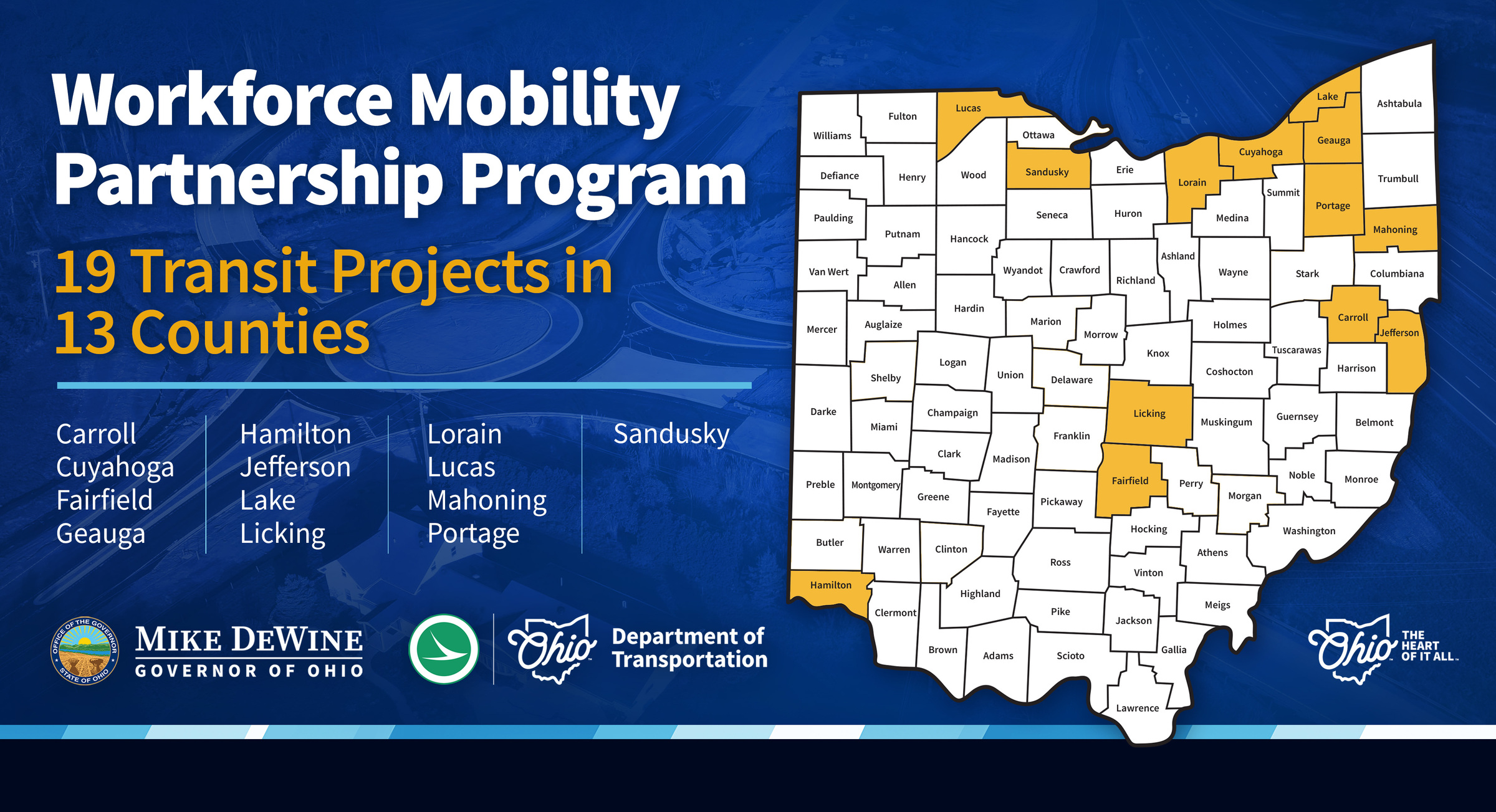
Last week, the DeWine-Tressel Administration awarded $13.5 million to 19 transit projects that will increase the viability of transporting workers to significant employment centers.
The 19 projects are across 13 counties and will fund projects that range from technology to enhance accurate arrival times for the Greater Cleveland Regional Transit Authority to assisting the Steel Valley Regional Transit Authority (Jefferson County) to purchase new mobility vans.
A full list of projects that received funding is available here.
Top WEDNESDAY: OSU hosting webinar on data center electricity usage
On Wednesday, the Ohio State University's Department of Agricultural, Environmental, and Development Economics is hosting a webinar with Geoff Blanford and Tom Wilson, both of the Electric Power Research Institute, on how data center development is likely to affect electricity usage in Ohio and the United States at large.
The webinar is being held on Wednesday at 12:00 p.m. Registration is free and can be completed here.
OHPELRA AI Summit: Preparing Public Sector HR/LR for the AI Era
Artificial intelligence is changing the workplace—and county government is no exception. From HR operations and employee relations to risk management, policy development and workforce planning, AI presents both new opportunities and important questions for public-sector leaders.
The 2026 OHPELRA AI Summit, “Preparing Public Sector HR/LR for the AI Era,” will provide a practical, full day look at how AI is being used today and what organizational leaders need to know as this technology continues to evolve.
Join the Ohio Public Sector Labor Relations Association (OHPELRA) on Thursday, October 22, 2026, from 8:00 a.m. to 3:00 p.m. at the Quest Conference Center in Westerville for an interactive day focused on real-world applications of AI and its impact on public-sector human resources and labor relations. This training is open to OHPELRA members AND non-members.
County Commissioners, Administrators, HR/LR professionals and Risk Managers will gain insight they can bring back to their organizations as they consider the opportunities, challenges and workforce implications of AI.
Registration and event information are available through the National PELRA Event Portal found here.

Conference of adult-use cannabis industry oversight to be held on October 22
On October 22, the Ohio Division of Cannabis Control is hosting a conference on the state of the adult use cannabis industry in Ohio.
Sessions at the event will focus on how the state regulatory system works, a legislative update (featuring Senator Shane Wilkin and Representative Tex Fischer), the public health focus on preventing cannabis misuse, and the public safety enforcement perspective.
The event is free and 5.25 units of Continuing Legal Education (0.75 for each of the seven sessions) are available.
Those interested in attending must complete the registration form by October 9. The event is being held at the Hyatt Regency in Columbus.
OHFA hosting cohort for multifamily housing training
The Ohio Housing Finance Agency (OHFA) is is partnering with Grow America (a community development nonprofit organization) to create a training cohort for community development professionals.
There are only 20 spots available in the cohort, so if you or a staff member is interested, you should email communication@ohiohome.org sooner than later.
The program will consist of four classes, all of which will be held in-person at OHFA's office in Columbus.
- October 19-23, 2026
- Rental Housing Development Finance (HD420)
- December 7-9, 2026
- Computer Spreadsheet Analysis for Rental Housing (HD423)
- January 25-29, 2027
- Rental Housing Development Finance: Problem Solving and Deal Structuring (HD435)
- February 22-25, 2027
- Homeownership Finance (HD410)
State funding opportunities
The table below contains current state grant or loan programs. A more comprehensive list can be found on the Ohio Grants Partnership webpage.
Grant Program
|
Brief Summary
|
Eligibility Criteria
|
Amount Available
|
Application Due Date
|
| Rural EMS and Dispatch Modernization Grant Program |
To improve emergency medical services (EMS), public safety communications, and emergency dispatch capabilities in rural communities. The project is intended to strengthen emergency response systems through investments in technology, workforce development, communications infrastructure, and innovative models of care |
PSAPs, emergency dispatch centers, EMS, and Fire serving rural areas |
$12 million available
|
October 6, 2026 |
| Body-Worn Camera Grant Program |
To assist law enforcement agencies in establishing a body-worn camera program or to acquire body cameras and associated technology. |
Law enforcement agencies.
Cannot be used to support Corrections.
|
$5 million available
|
October 7, 2026 |
| Building Demolition and Site Revitalization Grant Program |
To provide funding for the demolition of commercial and residential buildings and revitalization of surrounding properties on sites that are not brownfields. |
The designated lead agency in each county
(Listed in "Lead Agency List")
|
$21.5 million available
|
October 16. 2026 |
| MARCS Grant |
To assist volunteer fire departments and small fire departments in acquiring systems and equipment to integrate into the Multi-Agency Radio Communication System. |
Volunteer fire departments and fire departments serving areas with less than 25,000 residents
[non-county grant]
|
Maximum award: $50,000
|
October 24, 2026 |
| H2Ohio Conservation Ditch Grant Program |
To provide reimbursement for the construction of two-stage and self-forming conservation ditches. |
Soil and water conservation districts and county engineers |
Unspecified
Reimbursement model
|
June 1, 2027
(Rolling until) |
Federal funding opportunities
The table below contains a sampling of current federal grant or loan programs. A full list can be found on Grants.gov.
Grant Program
|
Brief Summary
|
Eligibility Criteria
|
Amount Available
|
Application Due Date
|
| Crisis Response Training Program |
To improving law enforcement responses to individuals in crisis who have behavioral health conditions, intellectual and developmental disabilities, physical disabilities, and/or traumatic brain injuries. |
Two pots:
One for law enforcement agencies
One for correctional facilities
|
Max award: $650,000
No match required
|
October 5, 2026 |
| Reducing Injury and Death of Missing Individuals with Dementia and Developmental Disabilities Grant Program |
To support public safety efforts to reduce deaths and injuries of individuals with forms of dementia, such as Alzheimer’s disease, or developmental disabilities, such as autism, who, due to their condition, wander from safe environments. |
Law agencies and health care agencies |
Max Award: $150,000
No match required
|
October 5, 2026 |
| Promoting Resilient Operations for Transformative, Efficient, and Cost-saving Transportation (PROTECT) Planning Grants |
To assist entities in developing a Resilience Improvement Plan. |
General availability |
$79 million available
|
October 9, 2026 |
| PROTECT Resilience Improvement Grants |
To improve the ability of existing surface transportation assets to withstand one or more elements of a weather event or natural disaster, or to increase the resilience of surface transportation infrastructure from the impacts of changing conditions, such as sea level rise, flooding, wildfires, extreme weather events, and other natural disasters. |
General availability |
$551 million available
|
October 9, 2026 |
| PROTECT Community Resilience and Evacuation Route Grants |
To strengthen and protect evacuation routes essential for supporting emergency evacuations during emergency event. |
General availability |
$79 million available
|
October 9, 2026 |
| PROTECT At-Risk Coastal Infrastructure Grants |
To enhance the resilience of highway and non-rail infrastructure, including bridges, roads, pedestrian walkways, and bicycle lanes, and associated infrastructure, such as culverts and tide gates to protect highways, that are subject to risks associated with their coastal location. |
General availability to entities on coastlines, including Great Lakes |
$79 million available
|
October 9, 2026 |
| Title X Family Planning Services Grants |
To promote the general family planning programs and goals under Title X of the Public Health Service Act. |
General availability |
Maximum award: $22 million
Local match of between 1% and 10%
|
January 9, 2027 |
Top Each week Counties Current highlights the happenings in our counties in the words of their local media.
One story from each of the CCAO's five districts is highlighted, and on occasion other stories may be highlighted as well.
A paid subscription may be required to view the full article in some cases.
Northwest District
Sandusky County Commissioners freeze non-essential spending amid projected budget shortfall
WKYC, September 21, 2026
Officials in Sandusky County are hitting pause on spending and putting a freeze in place to help address a projected budget shortfall.
The county auditor told commissioners earlier this month that the county was looking at a projected $4.3 million shortfall, prompting the county to put a spending and hiring freeze in place as officials navigate through cuts to get finances back on track.
“It's an issue of doing our homework and getting things in line where they need to be without disrupting anything to the community,” said Marc Glotzbecker, county administrator.
Over the summer, commissioners alongside the county auditor identified potential budget shortfalls, estimated to be $4.3 million.
“I think there were a lot of factors that led to it. Some of it may be revenue versus expenses; it may be just shortfalls in the budget, unforeseen expenses. Just a lot of little things kind of built up,” said Glotzbecker.
In response, the county hit the pause button, freezing nonessential spending and hiring as of Sept. 1.
“The reason being is because we're trying to identify those shortfalls, get a handle on them. It's just easier to do if the goalpost stops moving. Commissioners did a similar thing back in the early days of COVID when there was so much uncertainty, so it's not anything new to Sandusky County to do this,” said Glotzbecker.
This means holding off on nonessential spending for things like supplies, repairs, maintenance and equipment.
But County Commissioner Scott Miller says essential public services will continue as normal, including EMS.
Northeast District
Commissioners 'disappointed' by late bills in Mahoning County clerk of courts Michael Ciccone
WKBN, September 24, 2026
All bills are paid in Mahoning County, but public officials tell WKBN they are disappointed by Michael Ciccone’s actions in his role as Clerk of Courts.
Inside the Mahoning County Courthouse, commissioners are optimistic about their efforts for the county. But since learning one officeholder failed to pay FirstEnergy bills on time, Commissioner Geno DiFabio called it “an embarrassment” to the county.
They feel Ciccone’s actions are a poor reflection on each public official in the county.
“It’s unnecessary,” DiFabio said. “It’s a simple process. Just do your job or just get it done because we’re all affected by it. And I don’t want anything to cast any dark light on Mahoning County, especially now when things are happening.”
Over a dozen bills from four months ago sat in limbo under the watch of the Clerk of Courts.
“I have never seen this before in my life. And I’ve been around the county for over 50 years,” said Commissioner Carol Rimedio-Righetti.
Commissioners said this isn’t the first time the county auditor has stepped in to help balance the books.
“I’ve never seen one clerk of court have any issues with bills in county courts at all,” Rimedio-Righetti said.
WKBN tried once again to meet with Ciccone, but was unsuccessful.
The fiscal officer, Brent Hanni, said Ciccone’s only there once every 30 days. That’s the required amount in the Ohio Revised Code.
WKBN also stopped by the Oak Hill title office to see if we could catch up with Ciccone there. Staff said they haven’t seen him on Thursday or earlier this week, either.
“That’s unacceptable to me, because if you’re elected to public office, if you ask somebody for your vote when they come to talk to you, or they need something, you better be there when they need you,” DiFabio said. “We’re very accessible. Our office is very accessible. That’s what public service is.”
The commissioners said they hardly see the Clerk of Courts outside of what’s required. They want to make sure residents receive the public service that they are owed.
Central District
Richland County commissioners proclaim Friday 'Dolly Parton Day,' make funding plans for Imagination Library
Richland Source, September 24, 2026
Parents across Richland County work “9-to-5” to put food on the table for their kids.
Dolly Parton believed that shouldn’t come at the cost of literacy, an effort she promoted around the world until her death Aug. 25 at the age of 80.
Richland County commissioners opened their meeting Thursday by officially proclaiming Friday as “Dolly Parton Day,” voting unanimously in support of Parton’s beliefs surrounding literacy.
Parton’s Imagination Library supplies free books to children aged 0-5 years old, with more than three million children registered worldwide and 300 million books gifted. More than 4,800 of those children are in Richland County.
“Dolly Parton was such a precious person on this earth, and it is very, very sad to see her go,” said Richland Public Health Commissioner Dr. Julie Chaya.
“However, her legacy will continue on, especially here in Richland County, with the Imagination Library.
“That program costs $135,000 a year to sponsor here in Richland County. The state of Ohio is very generous to sponsor half of that for our area, but we are responsible for paying for the rest,” Chaya said.
That left $65,000 to cover. Richland Public Health came into the meeting with $15,000 dedicated. Commissioner Tony Vero moved for the county to pay the remaining $50,000, “contingent upon the legalities to do so,” he said.
Southwest District
Clermont County sues Duke Energy over coal ash contamination
WCPO, September 24, 2026
Clermont County has filed a federal lawsuit against Duke Energy and other companies over coal ash waste at a former power plant it says threatens drinking water for 145,000 residents.
Clermont County filed the lawsuit Thursday (Sept. 24, 2026) against Duke Energy and several other companies over coal ash waste at the former Beckjord Power Plant in New Richmond.
In total, the lawsuit names the defendants as: Commercial Liability Partners, LLC (“CLP”), New Richmond Development Corporation LLC (“NRDC”), Duke Energy Beckjord, LLC, Duke Energy Ohio, Inc. (together, “Duke Energy”), Owlfly, LLC and TBDA Investments, LLC, all owners or former owners of the site
The old plant sits next to the Ohio River, near well fields that supply water to 145,000 residents. The county says unlined ash ponds at the site pose a danger to public health and the environment.
According to a release, the former coal-fired power plant generated CCRs as a byproduct, and CCRs were disposed of in and moved between on-site unlined ash ponds. The lawsuit alleges that the Beckjord property and the unlined ash ponds present an imminent and substantial endangerment to public health and the environment, and are in violation of federal and state law.
County commissioners gave the companies 90 days to clean up the site in June. Leaders say the companies did nothing.
“We said we would act if the responsible parties did not, and we have kept that promise,” said Clermont County Commissioner David Painter. “The responsibility for addressing conditions at Beckjord—and the cost of remediation—must fall on the parties responsible, not the residents of Clermont County.”
Southeast District
Jefferson County commissioners begin 2027 budget process as hearings near
WTOV, September 22, 2026
Jefferson County commissioners are beginning work on the county’s 2027 budget as fall begins and the end of the 2026 fiscal year draws near, with budget hearings expected to start soon.
Commissioner Tony Morelli said early budget requests indicate the county is facing a multi-million-dollar gap between expected revenue and proposed spending.
“If we the commissioners approved what was turned in already, we would be $5 to $6 million in the red before we started," Morelli said. "In other words, bringing in $19 million worth of revenue. With $25 to $26 million worth, I call them and ask what people want.”
Morelli said commissioners plan to meet with each county department during the hearings and will ask leaders to focus on what it takes to operate, rather than building extra money into their requests.
“We’re gonna have to be real tight this year," he said. "We’re going to have to have what’s it cost to run your department. And then, if pick one, water department, a judge, you name it, need more money. Uh, for some reason, maybe they had to hire another person, maybe some equipment, then come back to the commissioners and we’ll try to find that money somewhere else."
Morelli said the goal is to build a balanced budget by having county departments base their requests on realistic operating needs as commissioners move into the first phase of the budget process. Top OCTOBER 2
CCAO/CEAO Southeast District Meeting (Muskingum County)
OCTOBER 9
CCAO Board of Directors Meeting
OCTOBER 12
Columbus Day - Holiday
OCTOBER 14
CCAO/CEAO Northwest District Meeting (Putnam County)
OCTOBER 30
CEBCO Board of Directors Meeting Top
|
|
|