EIGHT DAYS REMAINING: TY 2026 authorization of piggyback property relief measures must be passed by June 30
The deadline for counties to authorize the permissive local ("piggyback") homestead exemption and/or owner occupancy credit is approaching in five weeks. For the relief measure to be effective for the current tax year (taxes payable in 2027), boards of county commissioners must adopt a resolution by June 30. Resolutions adopted after June 30 will be effective for the next tax year (taxes payable in 2028).
The duration of the authorization can be for a single year or multiple years.
As of June 13, CCAO is aware of the following counties that have acted on the piggyback options (list may not be exhaustive):
- Lorain County: Authorized the piggyback homestead exemption for TY 2026.
- Miami County: Authorized the piggyback homestead exemption for TY 2026.
- Richland County: Authorized the piggyback owner occupancy credit at the maximum 2.5% rate, for a continuing period of time.
As a reminder, the two piggyback options are:
- Local Homestead Exemption - Applied concurrently with the statewide homestead exemption. All homestead exemption recipients in the county would receive a second exemption in the same amount as the standard homestead exemption. No additional application would be needed for recipients.
- Local Owner Occupancy Credit - Applied concurrently with the statewide credit. The amount of the credit is set by the authorizing resolution, up to 2.5%. The credit is applied to the same qualifying levies that the statewide credit applies to (those approved before November 2013.
All taxing entities in the county are affected by the piggyback options, not just county levies. Additionally, property tax revenue foregone due to the piggyback options is not reimbursed by state, nor is there a mechanism for the county to hold other entities harmless.
More information about the piggyback options can be found in County Advisory Bulletin 2025-10 Property Tax Relief Options.
The third relief mechanism, rolling back or suspending inside millage, is more limited to just the county share and can be authorized at any point in the tax year. The Advisory Bulletin above discusses this option as well.
Three weeks until the 2026 County Classic Golf Outing!
Join us on Friday, July 10 for the County Classic Golf Outing at Glenross Golf Club in Delaware, Ohio. Whether you're playing to win or just enjoying the camaraderie, you'll spend the day supporting the Ohio Counties Scholarship Fund while enjoying great golf, food, drinks, and prizes.
Spots fill quickly, so gather your foursome and register today!
We look forward to seeing you on the course!

University of Michigan seeking participants for research study on utility-scale solar development
The University of Michigan is seeking county officials and staff who have experience with utility-scale solar energy projects, with a particular interest in speaking with individuals involved in planning, zoning, permitting, economic development, infrastructure, public works, public engagement, emergency services, road departments, or related decision-making processes.
The study is intended to help local government officials across the county understand how to navigate the complicated factors of community perspectives and economic development considerations.
Interviews will be conducted virtually, last approximately 60–75 minutes, and participation is voluntary and confidential.
Participants may receive a $100 gift card as a thank-you for their time, subject to any applicable workplace or ethics policies.
If you are interested in participating, please complete this brief form. You may also contact Uthman Olagoke, Design Science Ph.D. Candidate, directly at uthmano@umich.edu.
Additional information about the research is available here. Top Top Transportation improvement districts receive grants to enhance workforce transportation
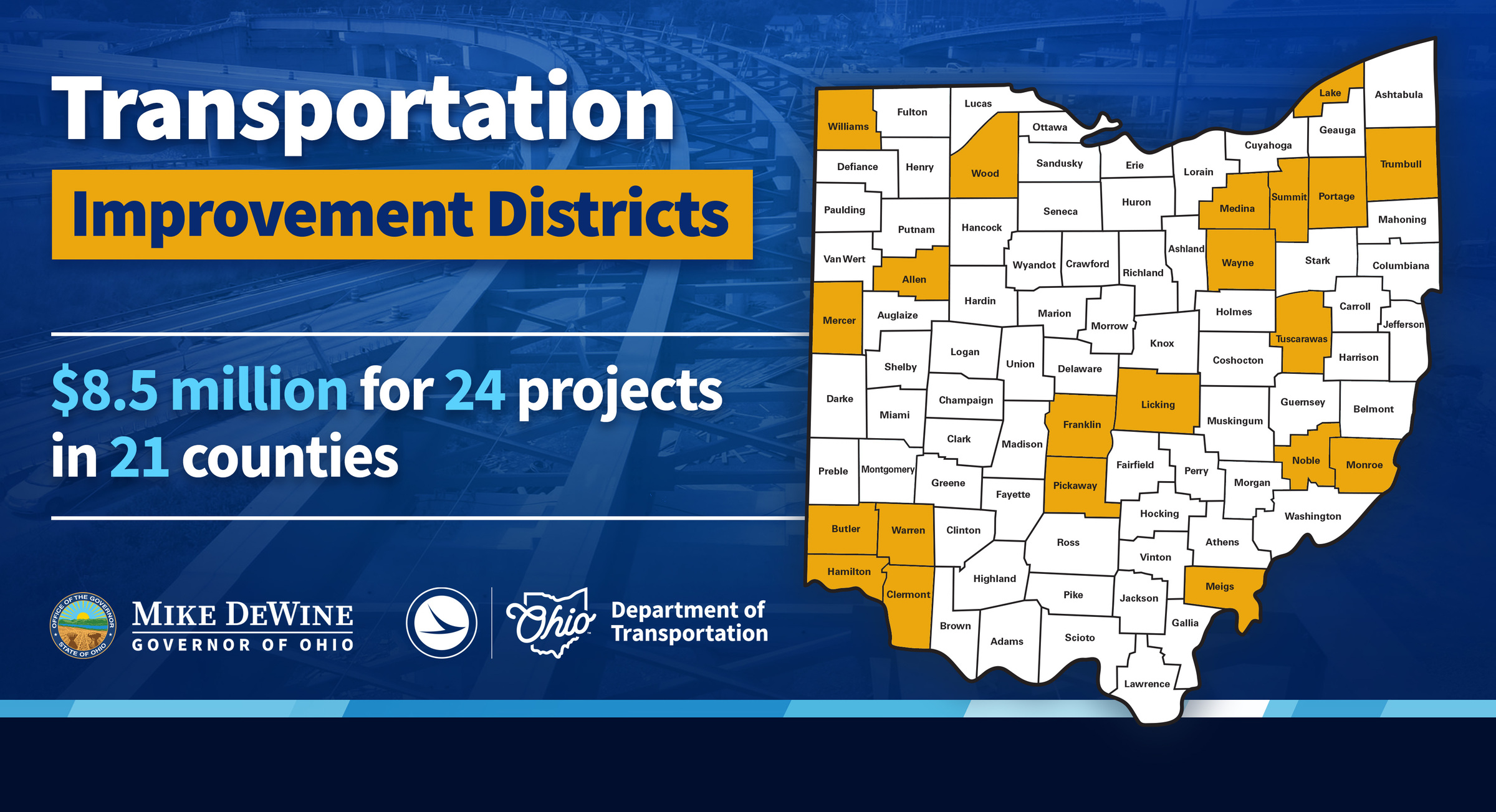
Last week, the DeWine-Tressel Administration announced the awarding of $8.5 million to support transportation projects across 21 counties.
The funded projects will support job creation and retention, economic development, intergovernmental collaboration, and public private investment.
The Ohio Department of Transportation estimates that the grants will support the creation of 1,071 jobs and the retention of 31,452 jobs. Funded projects range from $45,000 (to replacement a bridge in Meigs County and open up more land to development) to $500,000 (the maximum award, 10 projects received this amount).
A full list of funded projects is available here.
Opportunity Zones 2.0 process beginning, additional overview webinar to be held THURSDAY
Created by Congress in 2017, Opportunity Zones are federally designated, economically distressed census tracts that encourage private investment through targeted tax incentives. Investors who direct capital into qualifying projects within these communities may be eligible for federal tax benefits, helping spur economic development and revitalization.
After Congress made the program permanent last year, zones will be redesignated every 10 years. The next designation cycle begins July 1, 2026, when governors across the country will have a 90-day window to nominate eligible census tracts. Newly designated Opportunity Zones will take effect January 1, 2027, and remain in place through December 31, 2036.
Due to changes in eligibility criteria, some of Ohio’s original zones will lose their status.
There are 1,032 eligible census tracts in Ohio that meet federal requirements for consideration. Governor DeWine may nominate up to 258 tracts (25%) by September 2026 for designation by the US Department of the Treasury as Qualified Opportunity Zones beginning January 1, 2027.
To help inform those nominations, the Ohio Department of Development is seeking recommendations on which eligible tracts should be prioritized. Communities should consider factors such as the tract's importance to local master plans and the types of development intended for those areas, the existence of project-ready infrastructure, and previous state and federal investments made within the tract area.
The Department of Development's survey seeking information about eligible tracts can be accessed here. Please complete it by July 10.
The Department, along with the Greater Ohio Policy Center, is holding a webinar THURSDAY at 11:00 a.m. to discuss the changes to the program and how to be complete the survey. Registration for the webinar can be completed here.
Governor DeWine signs capital budget
This week, Governor Mike DeWine signed Senate Bill 450, the state capital budget, into law. Since the bill included an emergency clause, it took effect immediately upon the Governor’s signature.
One of the largest new items in this term’s capital budget is $346.5 million for mental health facilities, including a new facility in Montgomery County called the Miami Valley Behavioral Healthcare Hospital. While jail projects did not receive dedicated funding, this hospital may ease some cost pressures on county jails if it enables inmates to receive medical treatment there instead of in the jail.
As is tradition for the capital budget, it includes money for a host of local community projects. This term, community projects totaled $208.3 million. A review identified 59 county projects that received funding, including two small jail projects. These 59 projects total $13.9 million and are predominantly county fairground projects. Top Agenda announced, registration open for 2026 Innovation Summit on July 30
The Ohio Innovation and Technology Association (OITA) has opened registration for the 2026 Innovation Summit on Thursday, July 30, in Columbus.
The Summit, which traditionally includes cabinet directors, legislative leaders, local government officials, and private sector leaders, will have a focus on artificial intelligence this year.
Planned topics include:
- The State of AI
- AI Impact on Private Industry Sectors
- AI Demos from OITA Partners
- Data Centers & Energy Solutions
- AI Policy Discussions
- AI Deployment in Government
Registration for the event is open and accessible here. Registration costs $200 for OITA members, partners, event sponsors, and non-profits and local governments. The full registration price of $450 will apply to private sector attendees who are not OITA members, partners, or event sponsors.
Updates to grant tables
The following additions have been made to the grant availability tables below:
State Grants
-
Violence Against Women Grant Program: To fund programs aimed at reducing violent crimes against women. Application deadline is July 7.
-
Justice Assistance Grant Program: To fund a variety of aspects regarding criminal justice program areas. Application deadline is July 21.
Federal Grants
- Transit-Oriented Development Planning Program: To fund comprehensive or site-specific planning studies that will enhance economic development and enable mixed-use development, among other specifications. Application deadline is July 10.
- Continuum of Care and Youth Homelessness Program: To provide funding to enable the quick rehousing of homeless individuals, families, and other vulnerable populations. Application deadline is August 26.
State funding opportunities
The table below contains current state grant or loan programs. A more comprehensive list can be found on the Ohio Grants Partnership webpage.
Grant Program
|
Brief Summary
|
Eligibility Criteria
|
Amount Available
|
Application Due Date
|
| BroadbandOhio Line Extension Program |
To defray the costs of line extension for houses that are set back from main roads. |
Internet service providers
[NON-COUNTY GRANT]
|
$200,000 remaining |
June 30, 2026 |
| Violence Against Women Act Grant Program |
To fund local programs aimed at reducing violent crimes against women and assisting victims. |
Counties, law enforcement agencies, and other local governments
|
Max award: $60,000
Local match of at least 25%
|
July 7, 2026 |
| Ohio Developmental Disabilities Council Grant Programs |
A grouping of 16 individual programs intended to increase the quality of life of Ohioans with developmental disabilities. |
Broad availability, but entities serving individuals with developmental disabilities are best suited |
Varies by program, but all require a match of at least 33% |
July 10, 2026 |
| Edward Byrne Memorial Justice Assistance Grant Program |
To provide funding for initiatives, technical assistance, training, personnel, equipment, supplies, contractual support, and information systems in support of specified program areas. |
Counties and other local governments |
Max award: $150,000
Local match required
|
July 21, 2026 |
| Shine a Light on Dumpers Program |
To assist local governments in cleaning existing solid-waste dump sites and to take preventative action to deter future dumping. |
Counties and other local governments |
Max awards: $100,000 (clean-up projects);
$20,000 (deterrence projects)
|
July 31, 2026 |
Federal funding opportunities
The table below contains a sampling of current federal grant or loan programs. A full list can be found on Grants.gov.
Grant Program
|
Brief Summary
|
Eligibility Criteria
|
Amount Available
|
Application Due Date
|
| Great Lakes Restoration Initiative – Joint Venture Habitat Restoration and Protection |
To assist in the protection, restoration, or enhancement of migratory bird habitats within the Great Lakes coastal zone. Particular focus on projects that address declining habitat types. |
General availability among entities along the Great Lakes, with favor for projects within 15 miles of the coastline |
$800,000 available
Local match of at least 25%
|
July 6, 2026 |
| Pilot Program for Transit-Oriented Development Planning |
To fund comprehensive or site-specific planning studies that will enhance economic development and enable mixed-use development, among other specifications. |
General availability |
$24.5 million available
Local match of at least 20%
|
July 10, 2026 |
| Automated Permitting Systems Demonstration Grant |
To support jurisdictions that will deploy automated building code permitting systems and partner with HUD to evaluate their applicability and effectiveness within real-world operating conditions. |
General availability |
$3 million available
No match requirement
|
July 13, 2026 |
| Community Oriented Policing Services (COPS) Hiring Program |
To assist law enforcement agencies in hiring and/or rehiring career sworn law enforcement officers to assist in community policing capacity and crime prevention efforts. |
General availability for entities with law enforcement functions |
$157.6 million available, maximum award of $6.3 million
Local match of at least 25%
|
July 23, 2026 |
| Workforce Opportunity for Rural Communities Grants |
To support partnerships that will design and implement industry-driven training programs that will close skills gaps and boost the talent pipeline in critical sectors. |
General availability for entities within the jurisdiction of the Appalachian Regional Commission |
$49.2 million available
No match requirement
|
July 23, 2026 |
| COPS Law Enforcement Mental Health and Wellness Program |
To provide LEAs that do not have established law enforcement-specifc mental health and wellness programing with start-up funds to establish those supports. |
General availability for entities with law enforcement functions |
$9 million available
No match requirement
|
July 30, 2026 |
| Continuum of Care and Youth Homelessness Program |
To provide funding to enable the quick rehousing of homeless individuals, families, and other vulnerable populations. |
General availability |
$4 billion available
Local match of at least 25%
|
August 26, 2026 |
| Title X Family Planning Services Grants |
To promote the general family planning programs and goals under Title X of the Public Health Service Act. |
General availability |
Maximum award: $22 million
Local match of between 1% and 10%
|
January 9, 2027 |
Top Each week Counties Current highlights the happenings in our counties in the words of their local media.
One story from each of the CCAO's five districts is highlighted, and on occasion other stories may be highlighted as well.
A paid subscription may be required to view the full article in some cases.
Northwest District
Putnam commissioners discuss annexation question
LimaOhio.com, June 16, 2026
As discussions continue regarding a potential annexation of nearby residences into the village of Ottawa, Putnam County commissioners are continuing to discuss how to give residents in the county’s Sewer District 1, Sewer District 2 and those on the northern side of Pohl Road the best opportunity to make an informed decision on that question.
This question of annexation is not a new one, as the county faces U.S. Environmental Protection Agency requirements to hire someone to manage the county-owned sewer lines, potentially setting the county back as much as $150,000 per year. Annexation would have the village to maintain and repair the lines as part of its own system, allowing the county to get out of the business of managing these sewer lines.
“We’re going to give (affected residents) a pre-annexation agreement,” Putnam County Commissioner John Schlumbohm said. “Everybody’s going to get one. And if they are interested in annexing, they can fill it out, they can fill it out.”
Speaking at a public hearing in March, Ottawa Public Works Director Kyle Stechschulte said the 162 affected residents could see their costs go down by $2,000 a year should they agree to be annexed into the village, even taking the village’s 1% income tax into account.
“Off a general cubic usage, the average person being in the village would save money in the end,” he said at that meeting.
Schlumbohm noted that having residents footing the bill for maintaining their own system would be more expensive for them than annexation. He said when it comes to any tax issues, the income tax would not pose as great an impact as some residents may think.
Northeast District
Commissioners ask townships to examine siting rules for renewable energy projects
Gazette News, June 18, 2026
County officials sat down with local township representatives Monday evening, June 1, at A-Tech to present the process to implement state rules for siting wind and solar energy facilities and to ask townships for input in deciding whether and where they can be built.
Commissioner J.P. Ducro IV said the county wants to give townships a say, rather than making decisions “in a vacuum.”
Ohio Senate Bill 52 is a 2021 state law that significantly altered the approval process for utility-scale renewable energy developments by granting the county commissioners veto power over wind and solar projects. The law overrides the public utility exemption, giving boards the authority to prohibit or limit the size of large wind and solar facilities.
Counties can proactively designate restricted areas where wind and solar developments are entirely banned or establish energy development districts where they are permitted.
Rather than make the decision from Jefferson, Board President Casey Kozlowski said the board wanted to inform townships on what SB 52 calls for and get the trustees’ input before assembling a map for Ashtabula County.
SB 52 governs “economically significant” projects of between 5-50 megawatts, giving local townships the option to decide whether the entire township is open for renewable energy development, part of it or to close it altogether.
Projects of 5 megawatts or less are governed by local zoning codes, according to meeting materials.
The county can also have a project-specific response, according to Kozlowski. Until the county’s restricted area map is finalized, the county will operate on a project-specific basis, he added.
The commissioners are asking each township to identify areas where utility-scale projects should be restricted, if any, considering the needs of agriculture, economic development, residential areas, natural resources, local infrastructure and community identity, according to Kozlowski.
Central District
Fairfield County restricts Baltimore village jail use to ORC crimes
Lancaster News Eagle, June 18, 2026
The Baltimore village mayor's court will no longer be able to send prisoners to the Fairfield County Jail if they are convicted of crimes against village law until the village signs a contract with the county.
The county commissioners on June 16 passed a resolution prohibiting the county from housing the prisoners. The resolution takes effect in 90 days.
The jail will still accept those accused of crimes against Ohio Revised Code laws, however. The ORC says municipalities can use the county jail but must pay for the costs.
"It could get pretty messy pretty quick," Commissioner Jeff Fix said of housing prisoners accused of crimes against village laws. "The right way to do it is to have an agreement with the village of Baltimore, or any village in Fairfield County, and the sheriff's office saying we will house your people that you arrest and detain for arrests you made that are outside the Ohio Revised Code."
Sheriff Alex Lape said there is occasionally an inmate in the county jail from the Baltimore mayor's court. Fix said the issue stems from the Pleasantville mayor's court sending inmates to the county jail for those accused of breaking village laws. He said Pleasantville has since dissolved its mayor's court.
"It basically caused the sheriff to ask the question of, is this really the right way to do business?" Fix said. "And the answer was no, it's not. That (Pleasantville) brought it up and it caused us to examine the villages that have a mayor's court that do not have an agreement with the sheriff to take on their prisoners outside of the Ohio Revised Code."
Commissioner Steve Davis said the county needs contracts with mayor's courts so it's clear who is paying for what.
Southwest District
Warren County commissioners mull sales tax increase
Cincinnati Enquirer, June 15, 2026
A suburban Cincinnati county is considering raising one tax while eliminating another.
Commissioners in Warren County will decide whether to increase sales tax on retail purchases made within the county by up to a half cent. That would take the county's sales tax rate of the current 6.75% to 7.25%.
The board is also mulling a similar increase in the use tax on motor vehicles, watercraft and outboard motors.
Under Ohio law, county commissioners can raise sales tax by less than 1 percentage point without a public vote.
The increase in sales tax would allow the county to offer homeowners another property tax holiday in 2027, Commissioner Dave Young said. The county chose not to collect its share of property taxes from homeowners in 2022, dubbed a "tax holiday." That tax break cost the county, and saved taxpayers, around $24 million.
Property taxes mostly go toward school districts, but a small portion pays for county services.
"We're the most fiscally conservative people you're ever going to meet," said Young, referring to himself and the board's two other Republican commissioners. "If there's anyone that should try this, it should be us."
Property tax holidays aren't sustainable forever, Young said. "We need money."
But they could be with an increase in sales tax.
Young wants to try out the higher sales tax, coupled with a property tax holiday, for one year. Property tax would not be collected by the county in 2027. Commissioners need to vote on the resolution to increase sales tax before fall.
Southeast District
Belmont County Joins Stepping Up Initiative To Address Inmate Mental Health
The Intelligencer, June 18, 2026
The Belmont County Board of Commissioners adopted a resolution supporting the Stepping Up Initiative.
The initiative is intended to reduce the number of people with mental illness in the Belmont County Jail.
The initiative is a partnership between the county, the Belmont County Mental Health and Recovery Board and the jail.
Mental Health and Recovery Board Director Patty Allen said the resolution is simply a way to formalize what the county is already doing.
“Stepping up is really just formalizing a system that we already have in place. Several years ago, the mental health board partnered with the county commissioners and the Belmont County Jail to fund and place a social worker within the jail,” she said.
According to the Ohio Department of Mental Health and Addiction Services, the Stepping Up Initiative is a national initiative targeted at reducing the number of people with mental illnesses in jails.
“Without change, large numbers of people with mental illnesses, many with co-occurring substance use disorders will continue to cycle through the criminal justice system, often resulting in missed opportunities to link them to treatment,” according to the agency’s website.
Allen added it’s known that the majority of people in the jail struggle with mental health or substance use disorders.
“Stepping Up’s philosophy is to provide services and supports while people are in the jail and upon release, so that their mental health and substance use disorder needs are addressed, that they have recovery supports in place, so that they can become healthier, and it’s also an opportunity to reduce recidivism, which then makes the community safer,” Allen said. “It’s important to cut the recidivism rate because we want our communities to be safe. In order for our communities to be safe, our people need to be well. In order to be well, they need to receive many times mental health services, drug and alcohol treatment support, such as pro-social activities, housing, connection to positive role models that can help support them and offer them hope.”
She added that county jails have become the largest mental health providers in communities due to the number of people who have mental health and substance use disorders. Top JUNE 26
CEBCO Board of Directors Meeting
JULY 3
Independence Day (Observed) - Holiday
JULY 4
Independence Day, America's 250th Birthday
JULY 24
CEBCO Board of Directors Meeting Top
|